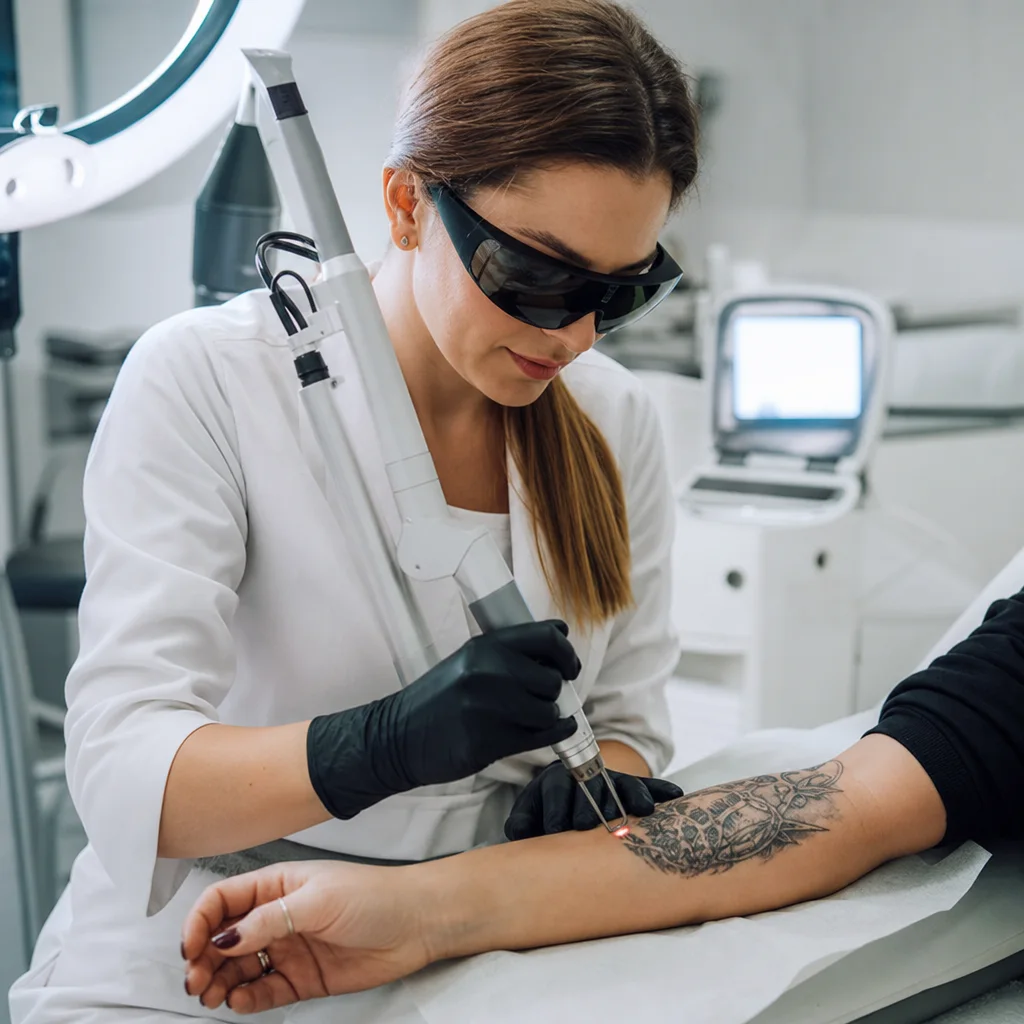
Artificial intelligence is rapidly penetrating medical aesthetics, and laser tattoo removal presents a particularly tractable application: the outcome (ink clearance) is visually assessable, the inputs (baseline tattoo characteristics, patient variables, treatment parameters) are largely quantifiable, and the clinical dataset accumulated over decades of practice is substantial. The convergence of these factors has produced a small but growing research literature on machine learning applications in tattoo removal — applications that range from clearance prediction to automated treatment parameter optimization.
The most direct clinical application of AI in tattoo removal is outcome prediction — specifically, predicting the number of sessions required to achieve a target clearance level for a given tattoo and patient. Existing clinical tools like the Kirby-Desai Scale approach this problem through simple additive scoring of manually assessed variables (tattoo age, colors, location, skin type, layering). Machine learning approaches offer the potential for substantially better prediction by incorporating more variables, modeling complex non-linear relationships, and learning from large outcome datasets rather than relying on expert-derived weightings.
A 2024 study from researchers at New York University developed a convolutional neural network (CNN) trained on 4,200 standardized photographs of tattoos with associated outcome data (sessions to ≥90% clearance, or failure to reach 90% by session 10). The model achieved an area under the receiver operating characteristic curve (AUC-ROC) of 0.88 for classifying tattoos as "likely to achieve 90% clearance in ≤8 sessions" versus "likely to require >8 sessions or not achieve 90% clearance" — substantially outperforming the Kirby-Desai Scale (AUC 0.71) on the same validation dataset. Importantly, the CNN extracted predictive features from the raw images that were not explicitly engineered by researchers, including subtle color distribution patterns and apparent ink density variations that human raters had not weighted in prior scoring systems.
Beyond pre-treatment prediction, AI applications have been developed for real-time treatment parameter optimization. One commercially developed system uses hyperspectral imaging of the tattoo site before treatment to measure ink concentration and depth distribution, then feeds this data into a machine learning model that recommends spot-specific fluence adjustments — essentially generating a per-tattoo treatment map rather than applying uniform parameters across the entire tattoo. A pilot clinical study showed that hyperspectral-guided parameter optimization reduced total sessions required by 1.8 (mean) compared to standard protocol treatment in a matched cohort design, though this non-randomized study design limits causal interpretation.
Image analysis AI for tracking clearance progress is perhaps the most immediately implementable application. Standardized photographic documentation of treatment progress is already standard of care in quality practices, but quantitative assessment of clearance percentage from photographs is time-consuming, subjective, and inconsistent between raters. Deep learning algorithms trained on annotated before-during-after photograph pairs have demonstrated high accuracy in automated clearance percentage estimation (mean absolute error of 6.2 percentage points vs. expert panel score in validation studies), enabling objective progress tracking at scale without physician time investment and providing consistent documentation for patient records.
The regulatory landscape for AI in medical aesthetics is still forming. The FDA has cleared several AI-based dermatological diagnostic tools under the 510(k) pathway, establishing precedents for how clearance outcome prediction tools might be evaluated. The critical distinction regulators are focused on is whether the AI system is providing decision support (flagging information for clinician consideration) versus autonomous decision-making — the former raising lower regulatory barriers. Current commercial AI applications in tattoo removal are positioned as decision support tools, which has allowed earlier market entry while the evidence base matures.
Looking forward, federated learning approaches — where AI models are trained across multiple clinical sites without centralizing patient data — offer a pathway to building the large, diverse datasets needed for robust, generalizable outcome prediction models. The tattoo removal field benefits from having outcome data that is visually assessable (facilitating semi-automated labeling) and that accumulates rapidly in high-volume practices. Within five years, AI-powered outcome prediction and treatment optimization are likely to be integrated into standard tattoo removal workflows in advanced practices, shifting the field toward quantitative, personalized treatment planning.