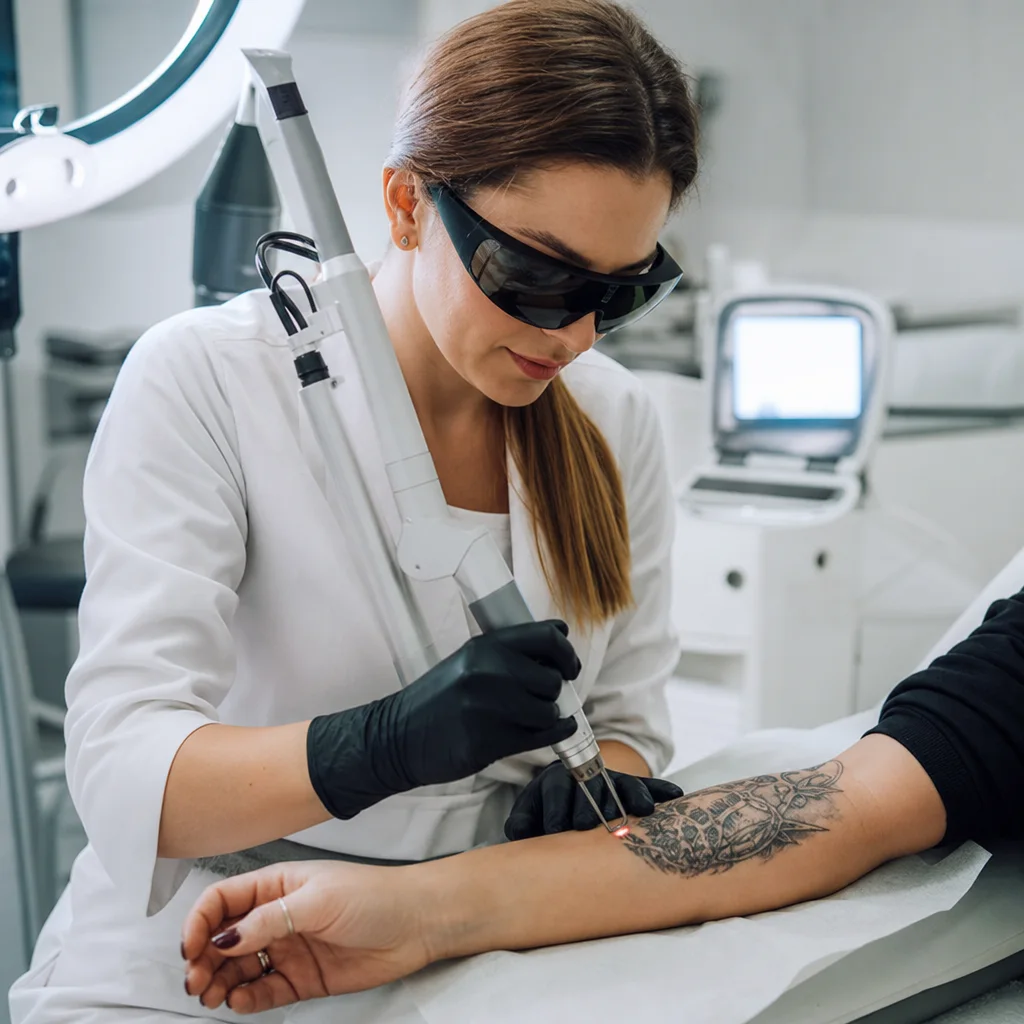
Laser tattoo removal is the most effective method available for removing unwanted tattoos from the skin. Unlike older methods — dermabrasion, surgical excision, salabrasion — laser removal targets the ink while leaving the surrounding tissue largely intact, enabling removal with a much lower risk of permanent scarring. Understanding how the technology works, what a realistic treatment course looks like, and what factors determine your individual results empowers you to make informed decisions about your care.
How Laser Tattoo Removal Works
Laser tattoo removal uses the principle of selective photothermolysis — delivering laser energy at wavelengths preferentially absorbed by tattoo ink chromophores rather than surrounding tissue. When ink particles absorb laser energy faster than they can dissipate it as heat (the principle of thermal confinement), they shatter into smaller fragments through a photoacoustic mechanism. These fragments are small enough to be engulfed and transported by macrophage immune cells, which carry them through the lymphatic system and deposit them in regional lymph nodes, where they remain permanently but are no longer visible in the skin.
Modern laser tattoo removal uses Q-switched (nanosecond) or picosecond pulse durations — extremely short bursts of intense laser energy. Picosecond systems, the current standard of care, deliver pulses measured in trillionths of a second, creating more efficient photomechanical fragmentation with less thermal damage to surrounding tissue compared to nanosecond systems.
How Many Sessions Will You Need?
The number of sessions required to clear a tattoo varies substantially based on multiple factors. The Kirby-Desai Scale, a clinical assessment tool, considers six variables: Fitzpatrick skin type, tattoo location on the body, ink colors present, amount of ink, scarring or tissue change in the tattoo, and tattoo layering (cover-ups). Each variable is assigned a point value and the sum provides a session estimate range. Black-ink tattoos on fair skin in a location with good lymphatic drainage (close to the trunk) may clear in 5–8 sessions. Multicolor professional tattoos on lower limbs in darker skin types may require 15–20+ sessions. The honest answer to "how many sessions" requires assessment of your specific tattoo and skin — no number given before examination is reliable.
The Treatment Process: Session by Session
A typical tattoo removal session begins with cleaning the treatment area and applying topical anesthetic (lidocaine cream) under occlusion for 45–90 minutes before treatment. The practitioner assesses the tattoo and selects device settings appropriate for your skin type and ink colors. During treatment, chilled air or contact cooling is applied to protect the epidermis. The laser is applied systematically across the tattoo — you will feel brief, sharp stinging sensations with each pulse. Immediately after treatment, the area shows frosting (temporary whitening from gas formation), redness, and swelling. Sessions typically take 5–30 minutes depending on tattoo size. Most patients schedule sessions 6–8 weeks apart to allow full healing and immune clearance between treatments.
What to Expect: Progress and Timeline
Fading typically progresses across sessions, but not always linearly. Early sessions may produce dramatic visible lightening; later sessions often work on residual ink that is harder to access and fragment. The immune clearance between sessions (weeks 2–8 after treatment) contributes meaningfully to visible fading — the tattoo continues improving after the session, not just during it. Total treatment timelines for complete clearance typically range from 12–24 months for standard professional tattoos, accounting for the inter-session healing intervals. Patience is essential — realistic expectations built on accurate information, not marketing, produce the best patient experience.
Choosing Your Provider
The skill of the practitioner and the quality of the equipment are the two most important factors under your control as a patient. Look for: a practitioner with documented training specifically in laser tattoo removal, access to multi-wavelength capability appropriate for your ink colors, a medical director relationship if the practitioner is not a physician, willingness to perform a test spot if you have complex risk factors, and transparency about pricing, session estimates, and complication management. Compare 2–3 providers before committing to a treatment course.